Projects@anabrid · work in progress
Gate-based quantum computing on coupled oscillators
The Schrödinger equation for a finite quantum register is a linear system of coupled oscillators. That is old physics. What it costs to run a real circuit that way on real hardware is not.
The starting point is not ours and is not new. A quantum state on $N$ levels is a vector of complex amplitudes obeying a linear equation. A classical array of coupled harmonic oscillators obeys a linear equation of the same shape. Briggs and Eisfeld worked the correspondence out in detail. First for excitonic energy transfer, where the quantum coherences of a coupled-monomer aggregate are reproduced exactly by a classical dipole array.1 Then for coherent states built from classical oscillator amplitudes.2 Then in general, for an arbitrary network of two-level systems, with coupled electrical circuits named as the hardware it would run on.3 Skinner gives the mapping of the quantum states of an arbitrary $N$-level system onto the positions of classical coupled oscillators directly.4
The correspondence
Write the register's amplitudes as $c_n$. The Schrödinger equation
is linear and first order. Split each complex amplitude into a real pair, $c_n = q_n + i p_n$, and it becomes a real linear system of twice the size, in which $q$ and $p$ drive one another. That is the equation of motion of coupled oscillators. Site energies become frequencies, $\omega_n = \varepsilon_n/\hbar$, and the off-diagonal couplings become reactive couplings between them.
Nothing is approximated in that step. The approximation, where the scheme has one, comes from the regime the hardware must sit in. Couplings small against the carrier frequency, site frequencies close to one another, dephasing slower than either. Those are the conditions under which the rotating-wave picture holds, and they are the operating specification for any machine built this way.
A gate is the same statement over a finite time. Every unitary is
for some generator $G$ and angle $\theta$, so applying the gate means integrating $\dot{c} = -iGc$ for a time $\theta$. There is no gate model, no Trotter step, and no shot noise. There is also no error correction: what the machine does is the equation, including everything it does wrong.
The cost, stated plainly
The register has $2^N$ amplitudes, and every one of them needs its own pair of integrators. Three qubits is eight amplitudes and sixteen integrators; ten qubits would be a thousand amplitudes and two thousand integrators. The resource scaling is exponential in the qubit count, and no argument here changes that.
So this is not a route to a quantum computer. It is an exact classical emulation, on hardware that solves the emulating equation continuously rather than stepping it. That makes it a way to ask precise questions about gate sequences at small register sizes.
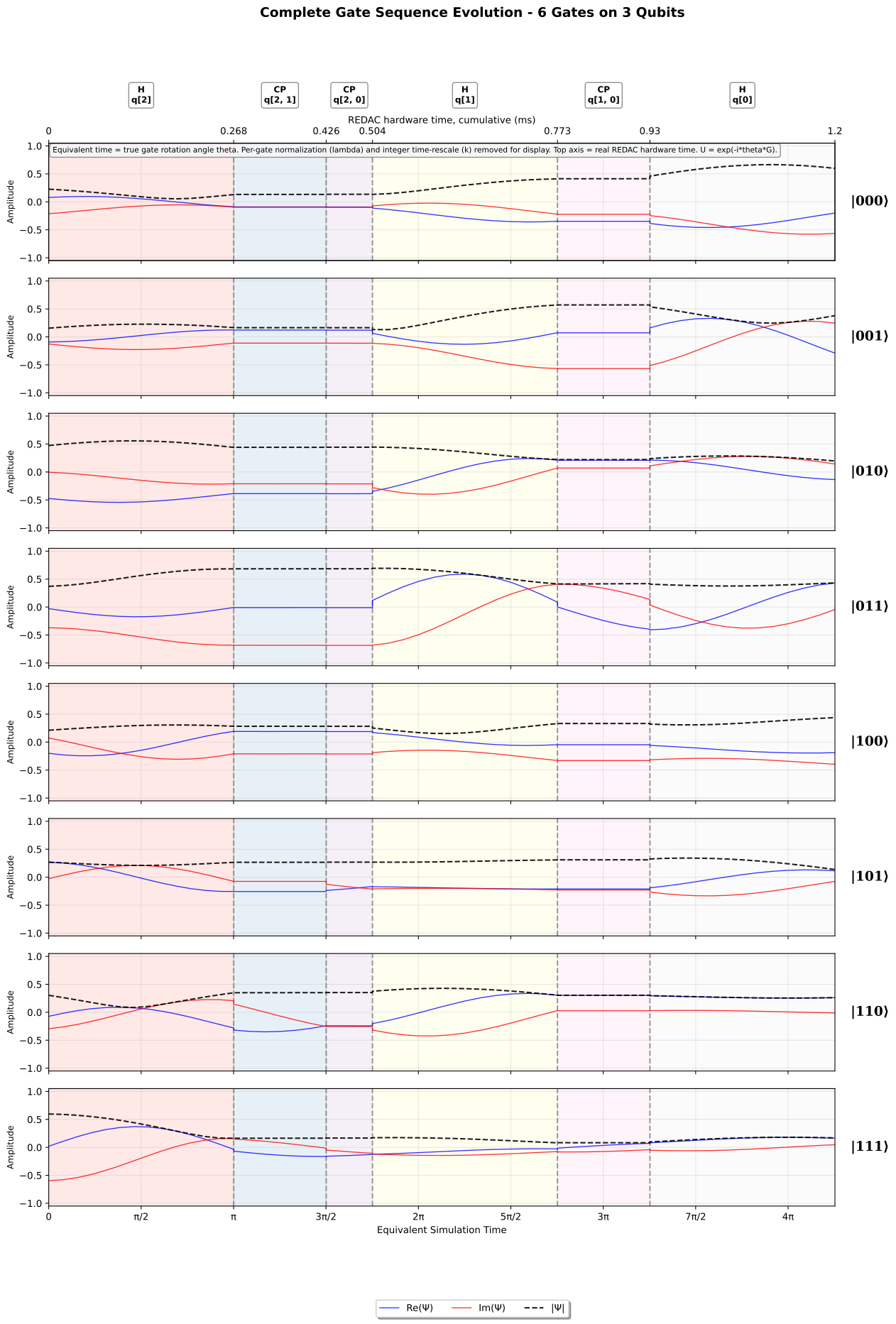
Three qubits, one transform
A quantum Fourier transform on three qubits, run as a single continuous evolution through the whole gate sequence. The amplitudes, against time.
What is behind the password
How closely individual gates reproduce their unitaries, what accuracy costs in run time, how the error grows with the rotation angle and with circuit depth, and which standard algorithms still return the right answer at which qubit counts. One of those answers is a boundary rather than a success.
-
J. S. Briggs and A. Eisfeld, Equivalence of quantum and classical coherence in electronic energy transfer, Phys. Rev. E 83, 051911 (2011). ↩
-
J. S. Briggs and A. Eisfeld, Coherent quantum states from classical oscillator amplitudes (2012). ↩
-
J. S. Briggs and A. Eisfeld, Quantum dynamics simulation with classical oscillators, Phys. Rev. A 88, 062104 (2013). ↩
-
T. E. Skinner, Exact mapping of the quantum states in arbitrary $N$-level systems to the positions of classical coupled oscillators (2013). ↩